

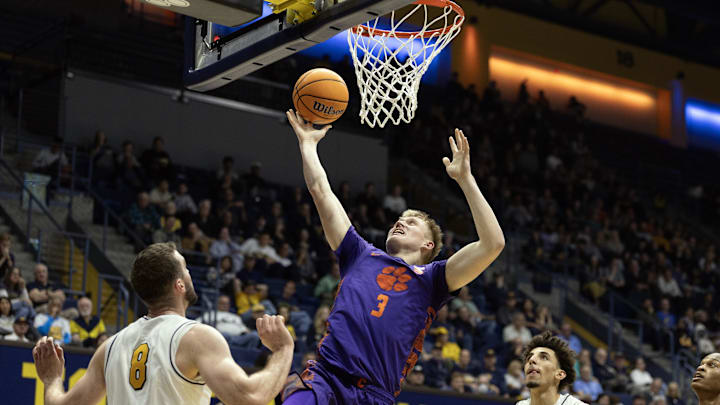
The 2025-26 Clemson Tigers still must get introduced to each other, on paper at least. After a roster overhaul of a magnitude that saw senior guard Dillon Hunter last season as the only returning non-freshman in the program, head coach Brad Brownell was about to embark on his "rebuild" season of the college athletics championship. Instead, he’s constructed a juggernaut.
The No. 20 Tigers’ standing in ACC standings at the moment is 19-4 and 9-1, sitting in sole possession of second place behind Duke. After a gut-check 66-64 win at Stanford on Wednesday, Clemson has now won 13 straight ACC road games since last season — a long streak — matching the historic 1972-74 NC State squads for the third-longest such streak in conference history. So, then how does a roster “cobbled together” with mid-major transfers and freshmen land a projected No. 6 seed in the NCAA Tournament by February?
ACC Network analyst and former Tiger guard Terrence Oglesby says the answer is 3 parts: Collective IQ, defensive detail, and the “positionless” scoring threat.
“This is a Clemson team, it doesn’t matter the night, it can be somebody different,” Oglesby reminded recently when the Tigers broke down.
"The Tigers don’t have a target for opposing defenses,” Oglesby, a former Clemson player from 2007-09, said after stepping into an assistant position under Brownell. Clemson operates under a “pick a guy, any guy” mentality, unlike high-volume alpha scorer teams.
There are numbers to support that saying. Oglesby said seven different players on the team have led scoring with different statistics this season for the Tigers. Nick Davidson’s interior presence, RJ Godfrey’s high-energy efficiency, or freshman player Ace Buckner’s electrifying spark on offense. In other words, the Tigers’ offense should punish the defense's weakest link rather than simply feed a star. Oglesby credits the offense with the highlights in play, but when it comes down to it, the team’s real power comes from their “defensive attention to detail.”
The Tigers rank in the top 15 nationally in adjusted defensive efficiency — a sign of what Oglesby calls their “Collective IQ.”
“They share the basketball. So, they’re smart,” Oglesby said. “They get it to the open guy, and they do such a good job just passing to the open guy.”
That intelligence trickles down to the defensive end, to where Brownell’s system demands constant communication and rotation — tasks that typically take years for a new roster to develop. For the ACC itself, the way the Tigers have managed to implement such sophisticated schemes with almost entirely new personnel is astonishing. Now, with a 9-1 conference score,
Clemson is no longer just a “feel-good” story; they pose as an actual threat to Duke’s dominance. The Tigers have won 12 of their last 13 games, and as the team prepares for an ambitious trip to Durham on Feb. 14, the "good mojo" surrounding the program is tangible.
For Brownell, a coach who is typically called the “perennial hot seat” among the national pundits, the season has been one to master in roster building from a construction point of view. Through his preference for “smart” players over “splashy” recruits, he has produced a team that combines the chemistry of a four-year veteran squad with the talent.
Or, as Oglesby argues, when your “smart team,” one that shares the ball, and that can source a different shiny young hero every night, can find and keep a new one all at a time — you’re not just winning games, you’re making history.
 Add us as a preferred source on Google