

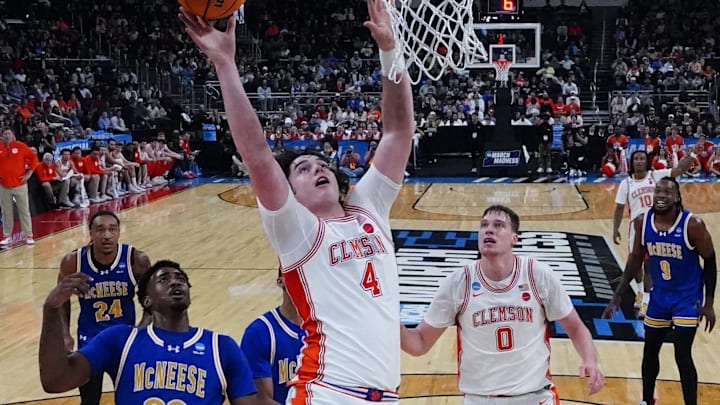
Ian Schieffelin was never meant to be like that. A former three-star recruit out of Georgia, he didn’t enter Clemson with dreams or standards of one-and-done stardom on offer but, after all, no, he hadn’t expected to do so.
What he did have coming with him was size, toughness and a desire to actually work — and four years later, precisely what made NBA teams care. Schieffelin doesn’t yell “future star.” He doesn’t need to. His interest comes from how many boxes he silently ticks. Schieffelin is 6-foot-8 and 240 pounds and already has an NBA-ready frame.
He is a physical player who has zero tolerance for avoidance, wins contact every time there is one and always wins games around the rim. His improvement has been consistent and obvious for his Clemson career … the sort of progress that scouts believe in because it demonstrates a coachable and adaptable player.
Offensively, Schieffelin has matured into a clever scorer who knows his limitations and plays in them. Most of his damage is in the paint and midrange – his strength and touch permit it as the ball strikes through traffic, which are on the court, where he has to play off of the shots made from corners and the field of play. But he’s not stuck there. The three-point shot has been a work in progress in itself – and that’s the kind of swing that will ultimately determine his future in the NBA.
As a junior, Schieffelin shot better than 45 percent from deep, but low volume. In the second season, he tried more and more, and the number went down. That’s more of a developmental curve than red flag. The form is solid. The willingness is there. And perhaps most important, he’s a reliable free-throw shooter, which sometimes marks shooting upside at the next level.
The true place that Schieffelin separates himself is on the glass. He is a double-double machine, one who consistently pulls down rebounds regardless of position or physical condition by muscle, positioning and effort. Nor does he simply rely on athleticism alone-he reads the ball, anticipates misses and goes on extra possession creation. That talent alone makes it into minutes in the NBA, especially for a team in search of a big guy with energy who doesn’t require touches drawn up for him.
Schieffelin has also an offensive connective value. He’s a good positional passer who keeps the ball moving, understands spacing, don’t commandeer possessions. That counts on NBA benches, where role clarity frequently decides longevity.
Defensively, the projection is apparent. Schieffelin isn’t a center at the next level. He doesn’t have the length or vertical pop to handle true NBA fives on a regular basis for the most part. But he is good enough as a forward defender. And as a forward defender, he holds his own. He has also got enough footspeed and athleticism on the perimeter for short bursts to outlast defenders in narrow flashes, and sufficient muscle to defend on the inside when the matchups require it.
That versatility — situational or otherwise — allows him to remain playable. At 22, Schieffelin is older than a fair amount of draft prospects. But there’s nothing bad about that for teams which draft second-round. It’s an advantage. He’s physically mature and mentally developed and much closer to contributing than it would be when he required years of seasoning. Which is why he sounds like a potential second-round pick.
No star promises. No marketing sizzle. Nothing but a consistent, physical forward with rebounding instincts, shooting upside and four years of getting better.
Not all of this is at all surprising for Clemson fans. Ian Schieffelin didn’t become an NBA prospect overnight — he accrued it the same way he earned everything else: by doing the work, embracing his role, and continually growing his game. And sometimes that is the mold that teams look for a player. ChatGPT can make mistakes. Check
 Add us as a preferred source on Google