

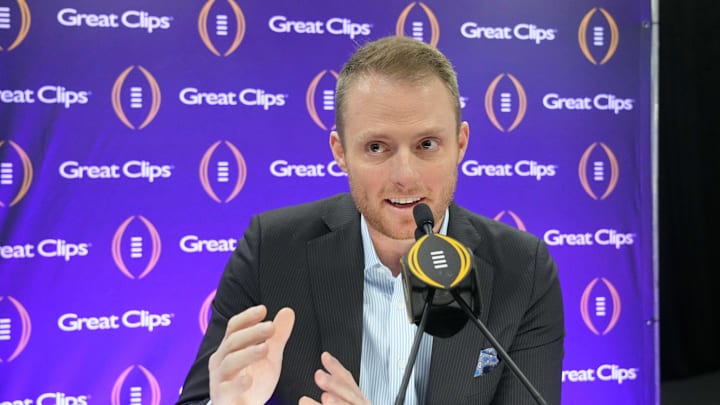
When Dabo Swinney went to the podium on Jan. 23 and called Ole Miss by name, it wasn’t just another coach crying the transfer portal out. It was a line in the sand.
Clemson’s head coach didn’t tiptoe around the issue. He did not discuss hypotheticals. He plotted a timeline, addressed Ole Miss head coach Pete Golding directly and described what occurred with linebacker Luke Ferrelli as “blatant” tampering — something Swinney called “Tampering 301.
” That’s exactly why, according to ESPN analyst Greg McElroy, this situation sounds so different from the dozens of tampering complaints that often evaporate into thin air.
“It isn’t that Dabo called out Ole Miss,” McElroy said on Always College Football. “Well, this isn’t that Ole Miss was supposedly acting in an inappropriate way, either. It’s what could be done about it?”
That question is central to the whole controversy. The expectation is almost as simple as this: Nothing happens when tampering allegations come out the door. A hush, a slow investigation, a response delayed and sometimes tepid too — it could have even been a stern, formal letter years later, when no one cares anymore.
McElroy even joked that the NCAA’s traditional timeline is “four and a half years.” But this time? The NCAA responded nearly instantly.
After Swinney released details that Clemson had turned Ole Miss over, the NCAA Vice President of Enforcement Jon Duncan gave a public statement that the NCAA would probe any claims, deeming them "credible allegations" and calling for complete cooperation from everyone.
For McElroy, that was enough to raise eyebrows.
“The NCAA has now already responded. That really never happens,” he said. “To say we’re investigating credible allegations — that is lightning speed this quickly for them.”
Why the urgency? Due to what Swinney claimed really happened.
Golding texted Ferrelli directly after Ferrelli had enrolled at Clemson, signed his financial aid agreement, and was participating in activities on the football field — while sitting in a classroom at Clemson, the report said.
Days later, Ferrelli logged back through the portal and announced dedication to Ole Miss. If true, McElroy thinks that crosses a line college football hasn’t quite found its way to yet.
“If you’re texting an enrolled student, or some other person technically a Clemson Tiger, who is sitting in a classroom at Clemson,” McElroy said, “that’s a whole new level of poaching.”
Which is why McElroy described the situation as at the verge of tortious interference — language seldom used in college football conversation but ubiquitous in the business world. That’s where
Swinney’s approach is notable. Instead of complaining broadly about the portal, grumbling about “the system,”
Swinney came with specifics.
Dates.
Actions.
A step-by-step story of how Clemson thinks it lost a player already on campus.
“You may not actually agree with his stance on the portal,” McElroy said. “You may not think that way about how he runs his program. You may think he’s stubborn. But if he has receipts — and if he’s giving the NCAA the easiest layup they’ve ever had — this is how you eventually get to be able to curb this behavior.”
Swinney didn’t come off at Ole Miss, either. He challenged coaching as a profession, imploring colleagues not to whisper privately and instead to behave publicly. Either make programs accountable, Swinney contended, or quit complaining entirely. McElroy said, emphatically.
“There should be a kangaroo court for coaches,” he said. “We need more coaches to actually call out schools, specifically with documents line by line, that demonstrate what went down.”
In McElroy’s opinion the sport stands at a crossroads. Everyone knows tampering is all around you. Everyone complains about it. By naming names, almost no one is prepared to risk backlash. Swinney did. And that’s why this case concerns people much bigger than Clemson and Ole Miss.
“It can stop behavior if this comes down,” McElroy said. “If nothing happens here — if it doesn’t happen to Ole Miss and if these allegations are incorrect — then the party’s over. Right now, there are no rules.”
That is college football’s truth, and it is the reality now. Either the NCAA finally enforces its own rules, or it is essentially saying that tampering is just a part of the game. Swinney brought that conversation out into the open, and whether the sport was ready, or not.
“Tampering 301” is now officially in session, McElroy stated. The last exam is coming — and the audience — who, if anyone, passes, is everyone in college football.
 Add us as a preferred source on Google