

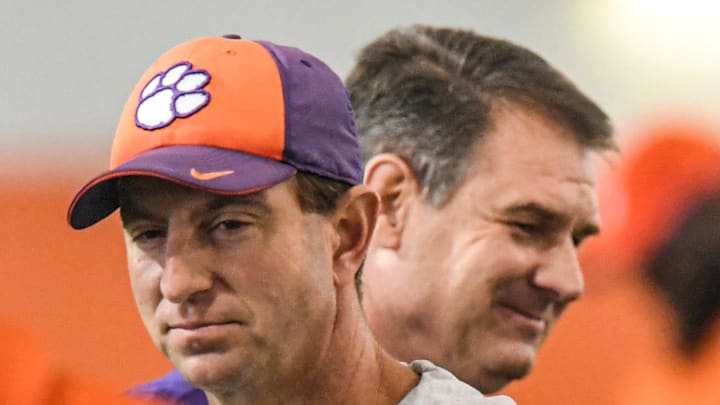
Dabo Swinney warned that change was coming. It didn’t take long.
Clemson’s coaching carousel officially spun into motion this week as offensive analyst John Grass accepted the head coaching job at Samford, marking the first confirmed staff departure following the 2025 regular season. The move signals the beginning of a reshaping process inside the Tigers’ program — one that will extend well beyond a single hire.
Grass won’t be leaving alone.
A Familiar Pipeline to Samford
Grass is building his staff with deep Clemson connections. Former Tigers quarterback Paul Tyson will join him as quarterbacks coach, while Andrew Zow, Clemson’s assistant running backs coach, is also making the move.
The most personal transition, however, belongs to Drew Swinney.
The Clemson head coach’s middle son is set to leave the program following the season and will become Samford’s wide receivers coach, earning his first opportunity to run a position group at the collegiate level.
A Proud Father, A Real Opportunity
During his Monday press conference, Dabo Swinney didn’t hide his excitement for what comes next for his son — or what the opportunity represents.
“I’m excited for Drew,” Swinney said. “Just going to be a great next step for him. Again, pretty cool that his first job to go run the [wide receivers] room is in Birmingham. My mom’s there, my in-laws are there. Because you don’t ever know. You have no idea where your first job to go run [the room] is going to be.”
Swinney emphasized that the move isn’t sentimental — it’s earned.
“He’s so prepared,” Swinney said. “He’s a stud. I know he’s my son, but he’s a stud. He’s going to be really, really good.”
Drew Swinney’s Clemson Chapter
Drew Swinney is finishing his third full season on Clemson’s staff, including his first year in offensive player development and as an assistant wide receivers coach. His departure marks the next step in a coaching path that has been methodical and deliberate.
Before coaching, Swinney spent five seasons as a Clemson wide receiver (2018–22), appearing in 40 career games. He played on teams that captured four ACC championships, earned three College Football Playoff berths, and won the 2018 national championship.
While his on-field role was limited — 14 career receptions for 96 yards — he became a trusted contributor, serving as Clemson’s starting holder on placekicks during his final season. Inside the program, his reputation for preparation and professionalism carried seamlessly into coaching.
Grass’ Resume Brings Credibility
Grass leaves Clemson after four seasons, most recently serving as senior offensive assistant and assistant quarterbacks coach under Garrett Riley. He originally joined the program in 2021 ahead of the Tigers’ Cheez-It Bowl victory and quickly became a respected presence behind the scenes.
This is not his first head coaching opportunity. Grass previously led Jacksonville State from 2013–21, earning OVC Coach of the Year honors in each of his first three seasons. Samford represents continuity — not a gamble.
“He’s just been great,” Swinney said. “Really a friend… and I’m really happy for him.”
What Comes Next for Clemson
Swinney confirmed that all departing coaches and analysts will remain with the team through the Pinstripe Bowl on Dec. 27 against Penn State, ensuring continuity through bowl preparation.
Still, this move feels like the beginning, not the end.
There are already rumblings that assistant offensive line coach Brandon Thomas and offensive player-development intern Montralius Mosley could also join Grass at Samford, though nothing has been confirmed.
Beyond that, Clemson will need to hire or promote a new safeties coach, with the potential for additional reshuffling as the national coaching carousel continues to spin.
A Program in Motion
Whether these early exits are about upward mobility, structural refinement, or simply the natural flow of the profession, one thing is clear: Clemson’s offseason transition is underway.
And if the first domino is any indication, more movement is coming.
 Add us as a preferred source on Google