

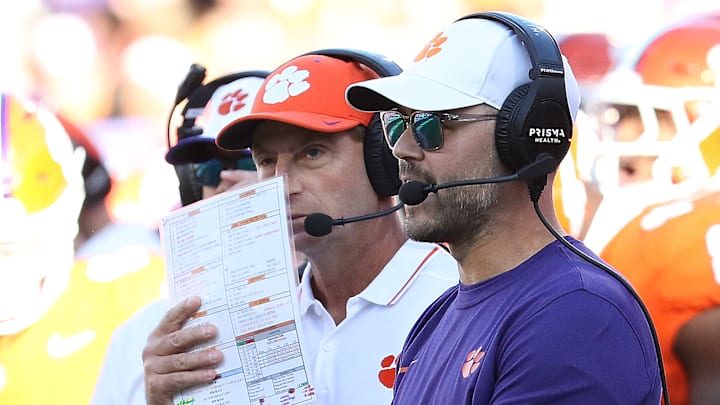
The numbers were already uncomfortable. The quotes made them unavoidable.
As Clemson prepares for the Pinstripe Bowl, the conversation around offensive coordinator Garrett Riley has shifted from schematic debate to something far more serious: alignment. Or, more precisely, the lack of it.
Riley was hired to modernize Clemson’s offense, to restore explosiveness and efficiency to a program that once overwhelmed opponents with speed and precision. Instead, the Tigers arrive in New York with a 7–5 record and an offense that rarely dictated games. Clemson averaged roughly 27 points per contest and struggled mightily in situational football, converting just over 34 percent of its third downs — a glaring red flag for a roster built with playoff expectations.
Those struggles have not gone unnoticed by head coach Dabo Swinney. Over the course of the season, Swinney’s postgame comments evolved from general frustration to pointed critiques, offering a rare public window into a strained coordinator–head coach relationship.
After an early loss in which Clemson failed to protect quarterback Cade Klubnik, Swinney placed responsibility squarely on the offensive staff.
“We didn’t do a good job helping him. That’s where Garrett’s gotta do a better job,” Swinney said. “We’ve got to make sure Cade is ready for some of the pressures he saw. A couple times he just got spooked — that’s on us too.”
As the season wore on and the offense continued to stall, the critiques became more direct — particularly regarding play-calling and the inability to establish balance.
“I don’t think we did a good job of calling it,” Swinney said after another uneven offensive performance. “We just didn’t do a good enough job of packaging some things together for him. … Schematically, we had some things that we just never got to. Just a frustrating day from that standpoint.”
Perhaps most telling were Swinney’s comments following a loss in which Clemson failed to execute basic concepts — the kind of breakdowns that suggest deeper issues than talent or effort.
“They didn’t do anything we don’t see every day,” Swinney said. “That’s the part that frustrates you. It’s day-one football, and we didn’t execute it. That’s on Cade, but it’s on us coaches too. We’ve got to put him in better situations.”
Around the program, those remarks have been interpreted as more than emotional venting. They point to a philosophical disconnect. Riley, a high-profile external hire, inherited an offensive staff largely built from Swinney loyalists, limiting his ability to fully install his system. Sources familiar with the dynamic describe an offense caught between competing identities — Riley’s scheme and Swinney’s deeply ingrained “All In” culture.
The results have reflected that tension. Clemson’s run game never stabilized, explosiveness vanished, and the offense often looked disjointed in critical moments. Advanced metrics echoed the eye test: a solid overall team propped up by defense, with an offense lagging behind championship standards.
Swinney has long preached unity — “one heartbeat” — as the foundation of Clemson’s success. By his own words this season, that alignment has cracked. At programs of Clemson’s stature, such fractures rarely linger without consequence.
Which is why the Pinstripe Bowl looms as more than a postseason exhibition. Against Penn State, Clemson has one final opportunity to show cohesion on offense — sustained drives, situational execution, and clarity of purpose. Anything less will only reinforce what the numbers and the quotes already suggest.
For Riley, the offensive architect brought in to reignite Clemson’s firepower, the margin for patience appears gone. And when a head coach says the failures are “on us coaches,” the clock is no longer ticking quietly.
 Add us as a preferred source on Google