

For years, college football coaches have talked about the "Wild West" quality of the transfer portal. But this week, those whispers were used at a megaphone scale as the NCAA headed toward unprecedented enforcement, in response to a high-profile controversy during this period involving Clemson and Ole Miss.
On Monday night, NCAA Vice President of Enforcement Jon Duncan sent a memorandum to Division I schools announcing a new mandate: a push for “significant penalties” for tampering infractions, as well as better public disclosure of such cases. The timing is not coincidental, coming just weeks after Clemson head coach Dabo Swinney put together a “receipt-heavy” timeline arguing that Ole Miss head coach Pete Golding had poached linebacker Luke Ferrelli when he was already taking classes at Clemson.
TThe friction started in January, when ACC Defensive Rookie of the Year at Cal, Ferrelli, signed with Clemson. As Swinney put it, the process rose from average recruiting to what he called “Tampering 301.”
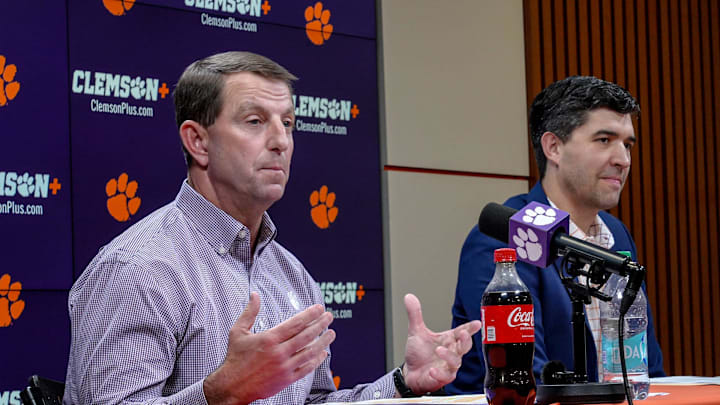
“There’s tampering, and there’s blatant tampering,” Swinney said during a viral January press conference. “Tampering 101 is when you’re speaking to kids who aren’t in the portal... Tampering 301 is when you’ve got a kid going to his or her classes and you’re textin’ them while in class. That's a whole new level."
Swinney detailed a brazen string of communications, alleging that Golding texted Ferrelli during an 8:00 a.m. class to ask about his buyout and sent a photo of a $1 million contract. Despite warnings from Clemson’s administration to Ole Miss, the Rebels reportedly doubled their offer to $2 million over two years. In the end Ferrelli went back to the portal and headed to Oxford.
“The NCAA was taken aback by a school stepping forward as directly and as transparently as we have,” said Clemson Athletics Director Graham Neff. “Normally, there is a lot of complaint in the media... very little actually gets reported.”
The NCAA’s memo also marks a shift in strategy, calling for an “infractions modernization task force” to accelerate investigations. The aim is to transition from multi-year probes to real-time accountability in the portal age.
“Communicating with an agent for a student-athlete who is not in the Transfer Portal is a tampering violation,” Duncan wrote in the memo. “If a coach is contacted by an agent... any further continuation of that discussion is considered a rules violation.”
The investigation has gone further, already reaching outside the Upstate. Fresno State recently joined the fray, delivering screenshots of presumed contact violations between Ole Miss and its leading receiver Josiah Freeman.
For Swinney, the choice to “turn in” a fellow coach was not about a single linebacker, but the protection of the sport’s governance.
“If tampering has no consequences, then we have no rules and we have no governance,” Swinney said. “This is not about a linebacker at Clemson… I blame the adults.”
Though critics disagree about whether the NCAA could lawfully enforce these penalties in today’s NIL environment, the Clemson-led effort has compelled the governing body to step in. Whether that leads to vacated wins, scholarship reductions, or recruiting bans is still the No. 1 issue in college football.
 Add us as a preferred source on Google